
Published · 62 min read
How to make a blast furnace in Minecraft, fast: craft or pick up 1 regular furnace, smelt 3 stone into 3 smooth stone, gather 5 iron ingots, then use a 3x3 crafting table with iron ingots across the entire top row, iron ingots in the middle-left and middle-right slots, the furnace in the exact center, and smooth stone across the bottom row. The finished Minecraft blast furnace is a specialist smelting block: it processes ores, raw metals, ore blocks, and metal armor or tools twice as quickly as a normal furnace, but it does not cook food, make glass, create smooth stone, burn logs into charcoal, or replace your everyday furnace.
This guide gives you the complete blast furnace recipe, the from-scratch material plan, the fastest smooth stone route, the Java vs Bedrock differences, the villager armorer job site use, the fuel math, and the common reasons the recipe will not show up. If you searched for "how to make a blast furnace in Minecraft" because your crafting output is empty, the most likely mistake is using stone instead of smooth stone, using slabs instead of full smooth stone blocks, missing the regular furnace in the middle, or trying to craft it in the 2x2 inventory grid instead of a crafting table.
Want to test the blast furnace recipe on a live world? Try a safe survival claim through Survival servers, compare mechanics on Java servers and Bedrock servers, or practice furnace-room layouts on Creative servers. Below, you will find a practical guide to Minecraft blast furnace crafting, blast furnace uses, automation, smelting speed, and the best ways to fit this block into a starter base, villager trading hall, mining outpost, or late-game storage system.
- Exact blast furnace recipe: 5 iron ingots + 1 furnace + 3 smooth stone blocks. Use a crafting table, not the 2x2 inventory grid.
- 3x3 recipe layout: top row = iron, iron, iron; middle row = iron, furnace, iron; bottom row = smooth stone, smooth stone, smooth stone.
- From scratch, plan for 11 cobblestone, 5 raw iron, and enough fuel for 11 smelts: 5 iron ingots, 3 stone, and then 3 smooth stone.
- A blast furnace smelts eligible metal-related items twice as fast as a regular furnace, but fuel is consumed at double speed, so the fuel-per-item value stays the same.
- Blast furnaces work for ores, raw iron, raw gold, raw copper, ore blocks, and iron, gold, or chainmail gear. They do not smelt food, logs, sand, clay, cactus, cobblestone, stone, or smooth stone.
- Villagers use blast furnaces as armorer job site blocks, making them useful for trading halls, iron armor trades, enchanted diamond armor routes, and village profession control.
How to make a blast furnace in Minecraft
The shortest answer is simple: to make a blast furnace in Minecraft, place 5 iron ingots, 1 furnace, and 3 smooth stone blocks into a crafting table. Put iron ingots in all three top slots, put one iron ingot on the left side of the middle row, place the regular furnace in the center, put the last iron ingot on the right side of the middle row, and fill the bottom row with smooth stone. When the items are in that exact shaped recipe, the crafting output becomes 1 blast furnace.
The most important detail is that the recipe uses smooth stone blocks, not stone, not cobblestone, not smooth stone slabs, and not regular stone slabs. Smooth stone is made by smelting stone one more time in a regular furnace. That means the path is cobblestone to stone, then stone to smooth stone. A lot of players get stuck here because older guides, server comments, and quick recipe images sometimes make the bottom row look like slabs. For the modern vanilla blast furnace recipe, use 3 full smooth stone blocks.
The second detail is that the center item is a complete furnace. You do not place cobblestone in the center to represent a furnace; you craft the normal furnace first, pick it up, and then use that furnace as an ingredient. If you are crafting a blast furnace from a fresh world, you need 8 cobblestone to make the furnace, 3 additional cobblestone to make the smooth stone, and iron ore or raw iron for the 5 ingots. The blast furnace is not a first-minute block like a crafting table, but it is easy to build once you have a stone pickaxe and a small iron vein.
In normal survival progression, the best moment to craft a blast furnace is after your first proper mining trip. If you return to base with raw iron, raw gold, or raw copper, a blast furnace pays off immediately because it cuts the processing time for those resources in half. If you only have a few pieces of iron and you still need your first pickaxe, shield, bucket, and shears, wait until those essentials are covered. The recipe costs 5 iron ingots, so it is cheap later, but it can feel expensive during the first ten minutes of a new Minecraft survival world.
On multiplayer Minecraft servers, the blast furnace recipe usually works the same way unless a server uses custom recipes, a datapack, a modpack, or a game mode with altered progression. Vanilla survival, semi-vanilla SMP, Lifesteal SMP, Skyblock, Towny, Factions, and Earth SMP servers commonly keep the normal Minecraft blast furnace crafting recipe. Modded servers can change it, especially if they use technology mods, progression packs, economy restrictions, or custom crafting tables. If the recipe does not work on a server, test it in singleplayer first before assuming the recipe is wrong.
Exact blast furnace recipe layout
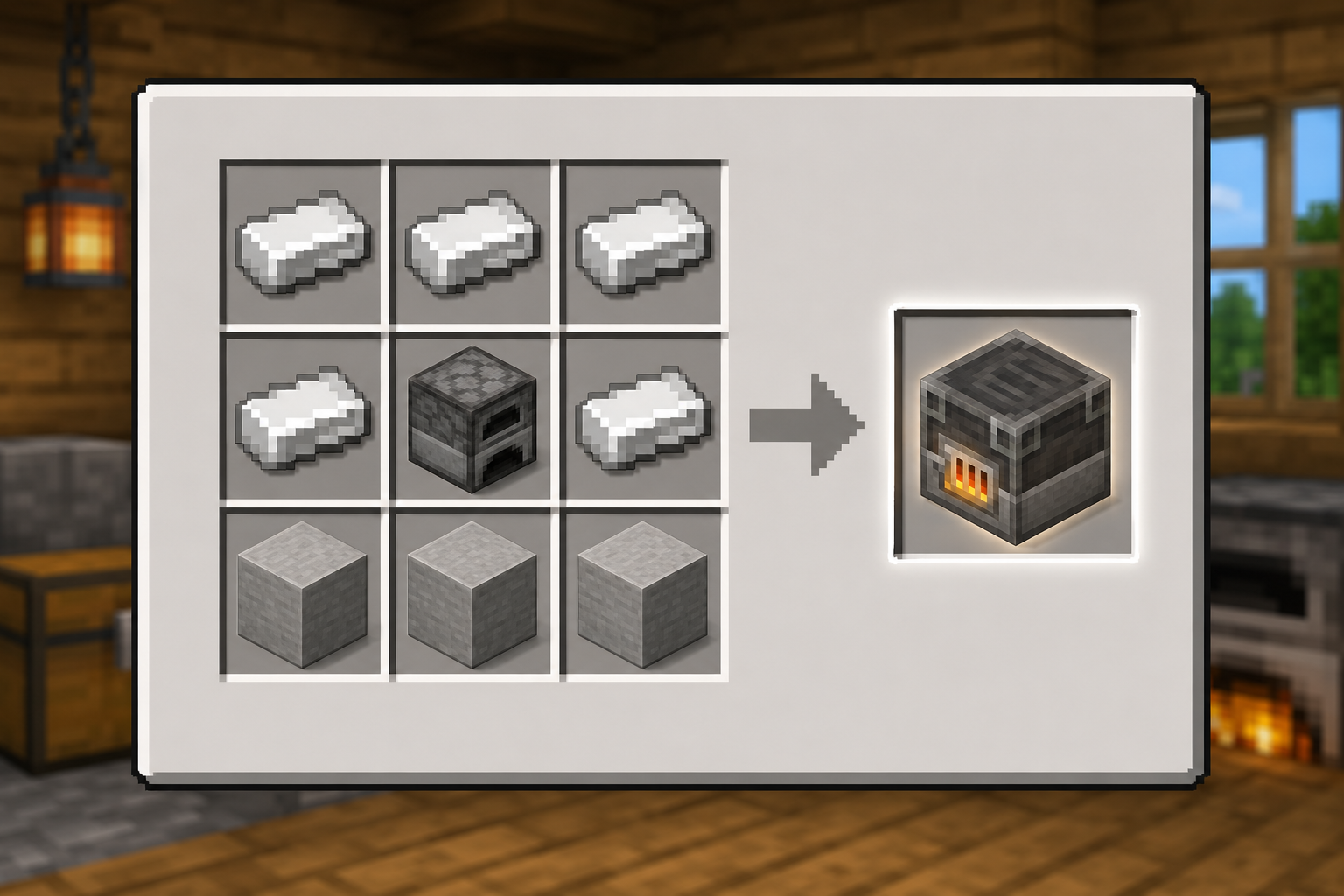
Use this exact coordinate map if you want the clearest possible answer to how to make a blast furnace in Minecraft. Read the crafting table as three rows and three columns. The top-left slot is row 1, column 1. The middle slot is row 2, column 2. The bottom-right slot is row 3, column 3. Because the Minecraft blast furnace is a shaped recipe, the positions matter. The same ingredients in the wrong order will not produce the block.
- Open a crafting table: A blast furnace cannot be crafted in your 2x2 inventory crafting grid. You need the full 3x3 crafting table because the recipe uses all three rows and has a furnace in the center.
- Fill the top row with iron ingots: Place iron ingots in (1,1), (1,2), and (1,3). This forms the iron cap of the blast furnace recipe.
- Place iron on the middle sides: Put an iron ingot in (2,1) and another iron ingot in (2,3). These two side ingots complete the total of 5 iron ingots.
- Place the furnace in the exact center: Put a normal furnace in (2,2). The furnace is the core of the recipe, and it must be an already crafted furnace block.
- Fill the bottom row with smooth stone: Place smooth stone blocks in (3,1), (3,2), and (3,3). Do not use stone, cobblestone, deepslate, stone bricks, smooth stone slabs, or regular slabs.
- Take the output: If everything is correct, the output slot shows 1 blast furnace. Shift-click on Java or use the quick output button on Bedrock to craft it instantly.
Written as a row diagram, the blast furnace crafting recipe looks like this: iron ingot, iron ingot, iron ingot; iron ingot, furnace, iron ingot; smooth stone, smooth stone, smooth stone. That one sentence is enough for experienced Minecraft players, but the longer explanation matters for new players because smooth stone and stone are two separate blocks. If your blast furnace recipe is not working, recheck the bottom row first.
Materials needed for a blast furnace
To craft one blast furnace, you need 5 iron ingots, 1 furnace, and 3 smooth stone. If you already have those materials in a chest, the block takes only a few seconds to craft. If you are starting from nothing in Survival mode, the real material path is slightly longer because the furnace and smooth stone both come from cobblestone. The clean starter plan is 11 cobblestone total: 8 cobblestone for the furnace and 3 cobblestone that will become stone and then smooth stone.
The iron requirement is straightforward. Mine iron ore with a stone pickaxe or better, collect at least 5 raw iron, then smelt it in a regular furnace to make 5 iron ingots. If you have Fortune on your pickaxe, one small iron vein can produce far more than 5 raw iron. If you are in the early game without Fortune, count on finding several iron ore blocks. Mountain biomes, stony peaks, caves, ravines, and exposed cliff faces are excellent places to collect iron quickly.
The smooth stone requirement is the part that makes the blast furnace recipe feel a little hidden. First, mine 3 cobblestone. Put that cobblestone into a furnace to get 3 stone. Then put those 3 stone blocks back into the furnace to get 3 smooth stone. Do not turn the smooth stone into slabs. For the blast furnace, the bottom row requires the full smooth stone block. This is different from the armor stand recipe, which uses a smooth stone slab, so mixing those two recipes is a common mistake.
The regular furnace is the easiest ingredient. Place 8 cobblestone in a crafting table around the outside edge and leave the center slot empty. That gives you 1 furnace. You can use cobblestone, cobbled deepslate, or blackstone variants depending on edition and version support, but the classic route is 8 cobblestone because it is available almost everywhere. After crafting the normal furnace, use it to smelt the iron and smooth stone, then pick it up with a pickaxe and place it into the center of the blast furnace recipe.
Fuel is the final practical requirement. From scratch, you need 11 smelting operations before you can make the block: 5 raw iron to iron ingots, 3 cobblestone to stone, and 3 stone to smooth stone. Two coal are enough because each coal handles 8 smelts in a normal furnace, giving you 16 total smelts of capacity. If you are using wooden planks, 8 planks cover 12 smelts, which is just enough with a little breathing room. Lava buckets are overkill for one blast furnace, but they are excellent if you are building a larger smelting room.
| Ingredient | Amount | How to get it | Common mistake |
|---|---|---|---|
| Iron ingot | 5 | Smelt raw iron in a regular furnace. | Using iron nuggets, iron blocks, or iron bars instead of ingots. |
| Furnace | 1 | Craft 8 cobblestone around an empty center slot. | Putting cobblestone in the center instead of a finished furnace block. |
| Smooth stone | 3 | Smelt cobblestone into stone, then smelt stone into smooth stone. | Using stone, stone slabs, or smooth stone slabs. |
| Fuel | Enough for 11 smelts | Use 2 coal, 8 planks, charcoal, or another normal furnace fuel. | Trying to make smooth stone inside a blast furnace, which does not work. |
From scratch: the fastest early-game route
If you want to make a blast furnace as early as possible in a fresh Minecraft world, start by punching a tree, crafting wooden planks, making a crafting table, and crafting a wooden pickaxe. Mine at least 11 stone blocks to collect 11 cobblestone. With the first 3 cobblestone, craft a stone pickaxe, because iron ore requires a stone pickaxe or better. If you are counting every block, mine extra cobblestone because you still need 8 for the furnace and 3 for smooth stone. In practice, mining 14 to 20 cobblestone is faster than counting perfectly while you are setting up.
Next, find iron. In modern Minecraft, iron appears in caves, underground stone layers, and higher mountain regions. Exposed iron in a cave wall is usually the fastest route. Mine at least 5 iron ore blocks, collect the raw iron, and head back to your crafting table. If you find more than 5 raw iron, take it. A blast furnace is most useful when you have a pile of ore to process, so extra iron means the new block can prove its value immediately.
Craft the regular furnace with 8 cobblestone, place it down, and start smelting. The smartest order is usually iron first, because you need the ingots for the recipe and early iron tools can help if you are still exploring. Add fuel, smelt 5 raw iron into 5 iron ingots, then smelt 3 cobblestone into 3 stone, and finally smelt the 3 stone into 3 smooth stone. This whole smelting chain takes about 110 seconds in a normal furnace if it runs without interruption.
While the furnace is working, do everything else: make more torches, organize your hotbar, craft a shield if you have enough iron, clear space for a small utility wall, or gather more fuel. Efficient Minecraft crafting is rarely about staring at the furnace GUI. Use the waiting time. By the time the smooth stone is done, you should already have the crafting table open or ready nearby. Break the furnace with a pickaxe so it drops as an item, then place it in the center of the blast furnace recipe.
If you are playing on a server with a public spawn workshop, the process can be even faster. Many SMP servers, Survival servers, and Towny servers have community furnaces, public fuel, starter mines, or shop systems where you can buy smooth stone and iron ingots. That changes the blast furnace from an early-game mining project into a simple crafting task. On Skyblock servers, the recipe may be part of a progression path, and smooth stone may require a cobblestone generator plus normal furnace smelting. Always check server rules before assuming vanilla progression.
How to get smooth stone for the recipe
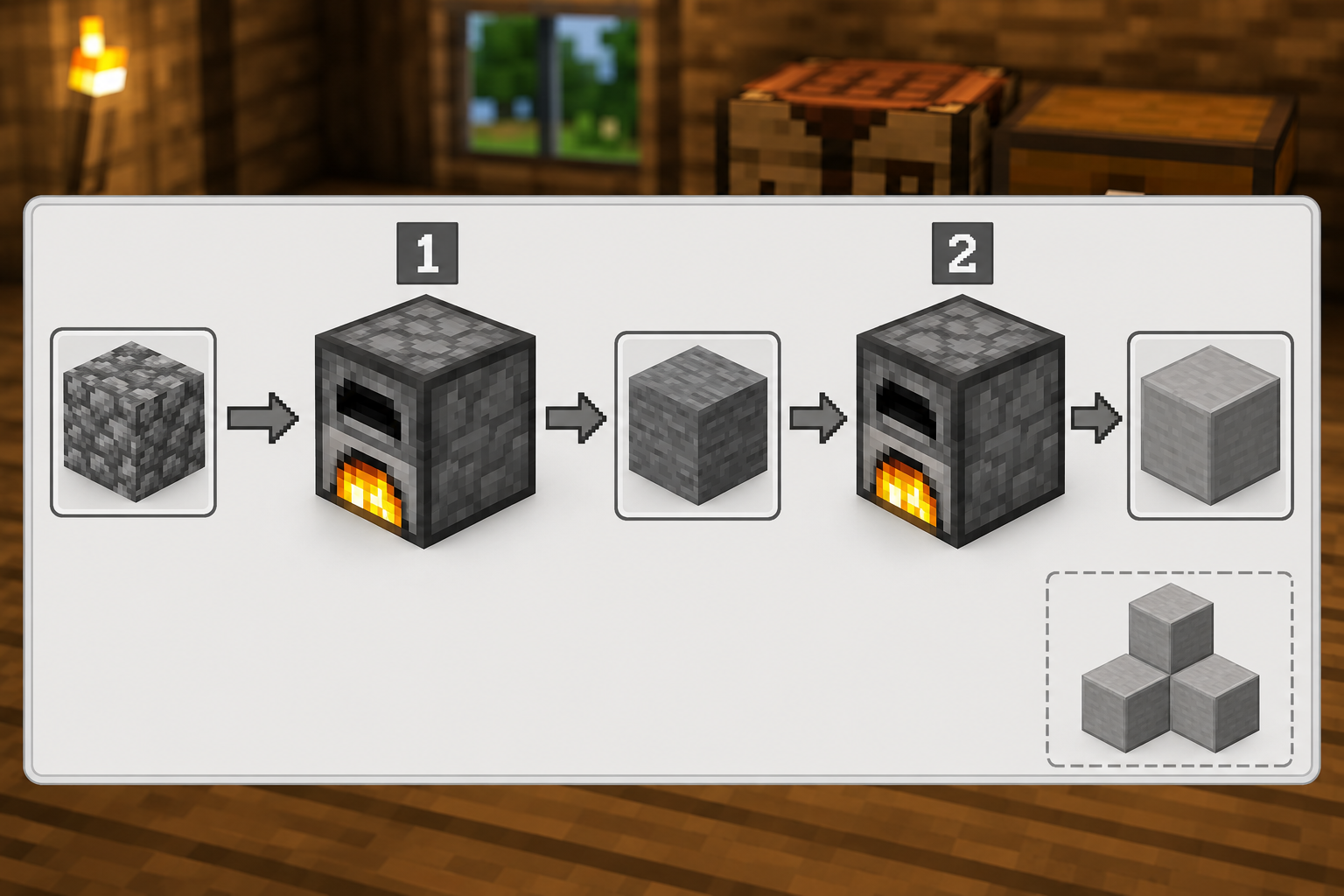
Smooth stone is the ingredient that causes the most confusion in almost every guide about how to make a blast furnace in Minecraft. The name sounds like it should mean normal stone, because normal stone already looks smoother than cobblestone. In the actual game, smooth stone is its own block. You make it by smelting stone in a regular furnace. Since stone itself is made by smelting cobblestone, smooth stone requires two smelting steps.
The exact smooth stone path is: mine cobblestone, smelt cobblestone into stone, then smelt stone into smooth stone. For one blast furnace, you need 3 smooth stone blocks, so you need 3 cobblestone for this part of the recipe. Each smelt takes about 10 seconds in a normal furnace. Three cobblestone to stone takes about 30 seconds, and three stone to smooth stone takes another 30 seconds. That is a total of about one minute just for the smooth stone.
Do not use the blast furnace to make smooth stone. This sounds silly because the article is about a blast furnace, but it is one of the most common Minecraft mistakes. A blast furnace cannot smelt cobblestone into stone and cannot smelt stone into smooth stone. It is only for metal-related smelting: ores, raw metals, ore blocks, and metal armor or tools. Smooth stone is made in a regular furnace, so you still want at least one normal furnace in your base even after you upgrade to a blast furnace.
Also avoid turning smooth stone into slabs before crafting the blast furnace. Smooth stone slabs are useful for armor stands, clean floors, modern builds, and decoration, but they are not used in the Minecraft blast furnace recipe. If you accidentally craft slabs, you cannot put slabs back together into full smooth stone blocks in vanilla survival. You will need to smelt more stone. That is why the safest route is to keep the three smooth stone blocks in your inventory until the blast furnace is crafted.
For bulk crafting, make smooth stone in batches. If you want four blast furnaces for a mining base, you need 12 smooth stone, 20 iron ingots, and 4 regular furnaces. Smelt 12 cobblestone into stone, smelt the 12 stone into smooth stone, and craft four furnaces with 32 cobblestone. This style of planning matters when you are building an efficient storage room, automatic smelter, villager trading hall, or ore processing wall, because the small recipe cost multiplies quickly.
What does a blast furnace do?
A blast furnace is a fast metal smelter. It smelts eligible items twice as quickly as a regular furnace, which means the processing time drops from about 10 seconds per item to about 5 seconds per item. It is best for raw iron, raw gold, raw copper, iron ore, gold ore, copper ore, ore blocks, and smeltable metal equipment. It is not a universal upgrade to the furnace. Think of it as the metal version of a smoker: a smoker cooks food faster, and a blast furnace smelts metal faster.
The biggest practical use is mining cleanup. After a cave trip, you might come home with stacks of raw iron, raw copper, and raw gold. A single regular furnace can process those resources, but it takes time. A blast furnace cuts that time in half. Several blast furnaces in a row can turn a messy mining chest into usable ingots very quickly. This is especially helpful if you are crafting rails, hoppers, anvils, beacons, iron blocks, gold blocks, powered rails, copper blocks, brushes, spyglasses, lightning rods, or decoration pieces.
A blast furnace also smelts iron, gold, and chainmail tools or armor into nuggets. This is not a great way to get rich, because one item only returns one nugget, but it is useful for cleaning up loot. If you collect damaged golden swords from zombified piglins, spare chainmail armor from mobs, or random gold gear from loot systems, a blast furnace can recycle that junk into nuggets instead of leaving it to rot in a chest. On economy servers, even small nugget returns can matter if you process gear in bulk.
Another major use is villagers. A blast furnace is the job site block for an armorer villager. If an unemployed villager can pathfind to an unclaimed blast furnace during work hours, that villager can become an armorer. Armorers are valuable because they can trade armor pieces, emeralds, and eventually diamond armor depending on the villager's level and the version's trade rules. In a trading hall, a blast furnace is not just a utility block; it is a profession-control block.
When active, a blast furnace emits light level 13, similar to a normal furnace. That means it can brighten a workshop while smelting, but it is not a reliable permanent light source because it only glows while burning fuel. It also has the same general furnace-style interface: input slot, fuel slot, and output slot. You can load it manually, feed it with hoppers, pull items out with hoppers, and connect it to chest systems for automatic ore processing.
What can a blast furnace smelt?
A blast furnace smelts metal-related items. The most common inputs are raw iron, raw gold, raw copper, iron ore, gold ore, copper ore, and their deeper variants when applicable. It also processes ore blocks that are smeltable, plus iron tools, gold tools, iron armor, gold armor, and chainmail armor. If the item belongs to normal stone, food, wood, sand, clay, plant, or miscellaneous smelting, the blast furnace will reject it. The input slot may accept nothing, or it may sit there without progress depending on the item and interface.
The easiest mental rule is this: if the output should be a metal ingot, metal nugget, or metal-related result, try the blast furnace. If the output should be food, glass, stone, charcoal, brick, terracotta, green dye, kelp, sponge, or anything non-metal, use a normal furnace or a smoker. This is why a good Minecraft base usually has three stations: a furnace for general smelting, a smoker for food, and a blast furnace for ores and metals.
Raw iron, raw gold, and raw copper are the best everyday blast furnace inputs. Since modern Minecraft drops raw metals instead of ore blocks unless Silk Touch is involved, the blast furnace naturally fits the mining loop. You mine raw resources, bring them home, and feed them into the blast furnace for quick ingots. If you use Fortune, the raw metal pile can become large, and that makes blast furnace speed even more valuable.
Ore blocks are also valid when you mine with Silk Touch. Some players prefer to collect ore blocks for decoration, storage, or Fortune mining later. If you decide to smelt those ore blocks instead, the blast furnace handles them faster than a regular furnace. The exact strategy depends on your enchantments. Fortune is usually better for raw metal yield, while Silk Touch is useful for transport, decoration, and controlled processing.
Metal gear recycling is the niche use. Smelting iron or gold tools and armor gives nuggets, not ingots. The return is low, so do not craft gear just to smelt it. Use it when the gear is already unwanted. Chainmail armor can also be smelted in a blast furnace, which gives iron nuggets. This is handy after mob farm sessions, dungeon loot cleanup, trial chamber runs, or server kits where old equipment piles up.
| Input type | Blast furnace result | Best use case | Use regular furnace instead? |
|---|---|---|---|
| Raw iron, raw gold, raw copper | Iron, gold, or copper ingots | Fast mining-trip processing | No, blast furnace is better for speed. |
| Iron, gold, copper ores | Ingots | Silk Touch ore processing | Only if you have no blast furnace. |
| Iron or gold tools | Iron or gold nuggets | Recycling damaged loot | No, blast furnace is faster. |
| Iron, gold, chainmail armor | Nuggets | Mob farm or loot cleanup | No, blast furnace is faster. |
| Food | Nothing | None | Use a smoker or furnace. |
| Cobblestone, stone, sand, clay, logs | Nothing | None | Use a regular furnace. |
Blast furnace vs furnace vs smoker
The regular furnace is the flexible worker. It smelts ores, cooks food, makes smooth stone, creates glass, turns clay into bricks, turns cactus into green dye, dries kelp, makes charcoal, and handles many other recipes. It is slower than the specialist blocks, but it accepts the widest range of inputs. Even after learning how to make a blast furnace in Minecraft, you should keep regular furnaces in your base because the blast furnace cannot do general smelting jobs.
The blast furnace is the metal specialist. It is faster for ores, raw metals, metal tools, and metal armor. The speed difference is noticeable when you process stacks. A regular furnace takes about 10 seconds per item, while a blast furnace takes about 5 seconds per eligible item. Fuel is used at double speed, so a piece of coal does not magically smelt twice as many items; it smelts the same number of eligible items in less time. The value is speed, not fuel efficiency.
The smoker is the food specialist. It cooks meat, fish, potatoes, kelp, and other food-related smelting recipes faster than a regular furnace. It does for food what the blast furnace does for metal. If you are building an efficient survival base, the clean setup is a small wall with furnaces for flexible jobs, smokers for food, and blast furnaces for ores. That gives you speed without losing recipe coverage.
New players often ask whether a blast furnace is "better" than a furnace. The honest answer is yes for metal, no for everything else. If you are smelting raw iron after mining, the blast furnace is better. If you are making glass for windows, it is useless. If you are cooking steak, it is useless. If you are making smooth stone for another blast furnace, it is useless. If you are recycling gold swords from a Nether farm, it is perfect.
For servers, this distinction can matter even more. In faction bases, prison mines, SMP storage rooms, and skyblock islands, players often optimize around the resource they process most. A prison server player who mines ore all day benefits from rows of blast furnaces. A farming-heavy survival player might care more about smokers. A builder needs regular furnaces for glass, terracotta, stone, and smooth stone. The best Minecraft utility room uses all three.
Fuel math: is a blast furnace more efficient?
A blast furnace is faster, but it is not more fuel-efficient. This is one of the most important details in a high-quality Minecraft blast furnace guide. The block smelts eligible items twice as fast, but fuel is consumed at double the rate compared with a regular furnace. In practice, the number of items smelted per fuel item stays the same. Coal still covers the same amount of eligible smelting work; the difference is that the work finishes faster.
For example, if a coal item normally smelts 8 items in a regular furnace, a blast furnace still gives you the same basic fuel value for eligible items, but the processing happens in about half the time. That makes the blast furnace a speed upgrade, not a resource-saving upgrade. If you are short on coal, the blast furnace does not solve your fuel problem. If you are short on time while processing ores, it absolutely helps.
This matters for early survival because some players rush a blast furnace thinking it will stretch their fuel. It will not. If fuel is your bottleneck, make charcoal, collect coal, build a kelp farm, use lava buckets, or improve your fuel supply. If smelting time is your bottleneck, craft more furnaces, more blast furnaces, or an automatic smelting array. The fastest ore processing systems combine multiple blast furnaces with hopper input, hopper output, and a reliable fuel line.
For a single player base, two to four blast furnaces are usually enough. One blast furnace is fine for casual mining. Two blast furnaces make raw iron and raw gold feel snappy. Four or more blast furnaces are useful when you use Fortune III, branch mine heavily, run a beacon mine, or collect copper for building. In late-game worlds, speed usually comes from parallel smelting: many blast furnaces working at the same time.
The best fuel choices depend on your world. Coal and charcoal are simple. Lava buckets are powerful and easy if you have dripstone lava farms or Nether access. Dried kelp blocks can be renewable but require setup. Bamboo can work in automatic systems, especially on versions where bamboo farms are easy to build. Planks are fine in emergencies but not ideal long-term. The blast furnace accepts normal furnace fuels, so choose fuel based on your base infrastructure rather than the block itself.
How to use a blast furnace
After you craft the blast furnace, place it like any other block. Right-click on Java or use the interact button on Bedrock to open the interface. Put an eligible item in the top input slot, place fuel in the bottom fuel slot, and wait for the output to appear on the right. If the input is valid, the arrow progress bar moves quickly. If nothing happens, the item is probably not accepted by a blast furnace, the fuel slot is empty, or the block is blocked by server rules or custom mechanics.
For manual use, keep the blast furnace near your mining chest. A simple early-game setup is one double chest for raw ores, one regular furnace, one smoker, one blast furnace, and one output chest. When you return from mining, put raw iron, raw gold, and raw copper into the blast furnace. Put food into the smoker. Put sand, cobblestone, clay, and other general smelting items into the normal furnace. This creates a clean workflow without any redstone.
For semi-automatic use, place a hopper on top of the blast furnace and connect it to an input chest. Place another hopper feeding into the side or back for fuel. Place a hopper underneath the blast furnace leading into an output chest. Items from the top hopper enter the input slot, fuel from the side hopper enters the fuel slot, and finished ingots leave through the bottom hopper. This is the basic Minecraft auto smelter pattern, and it works with blast furnaces just like it works with normal furnaces.
For larger systems, use multiple blast furnaces in parallel. Split incoming raw metals across several hoppers or use minecart hoppers to distribute items evenly. The goal is to prevent one blast furnace from doing all the work while the others sit empty. Even a simple row of four blast furnaces with four input hoppers can make a base feel much faster. If you are processing massive amounts of copper or iron, parallel blast furnaces are one of the easiest upgrades you can build.
Remember that blast furnaces can be broken and moved, but you need a pickaxe. If you break one without a pickaxe, it will not drop. This matters in starter bases, village workshops, and multiplayer claims. Always use at least a wooden pickaxe to collect your blast furnace. If the block has items inside, it drops its contents when broken, but it is still cleaner to empty the output first so you do not scatter ingots around your floor.
Using a blast furnace with villagers
A blast furnace is the job site block for an armorer villager. If you place a blast furnace near an unemployed villager, and that villager can claim it during work time, the villager may become an armorer. This is one of the most important non-smelting uses of the block. Armorers can become a strong part of a trading hall because they offer armor-related trades, emerald routes, and valuable gear at higher levels.
To use the blast furnace for a villager, first make sure the villager is unemployed and not a nitwit. Nitwits cannot take professions. Then place the blast furnace close enough for the villager to detect and claim. You should see profession particles and the villager's outfit change to the armorer profession. If another villager claims the block first, break and replace it near the correct villager. In trading halls, players often isolate villagers in cells to control exactly which job site each villager claims.
If the villager already has a profession and you have traded with it, the profession is locked. Breaking the blast furnace will not reset a traded villager back to unemployed. If you have not traded with the villager yet, removing the job site can let the villager lose the profession and take another one. This is the basic profession-reroll mechanic used in many Minecraft trading halls. For armorers, the blast furnace is the key block.
Armorers are especially useful on survival multiplayer servers because armor trades can reduce the need for repeated diamond mining. Depending on your version and trade setup, leveled armorers can provide iron armor, chainmail armor, diamond armor, bells, shields, or other armor-related trades. In older trading systems, players often rerolled villagers for strong diamond armor trades. In newer systems, village biome and trade balance changes may affect exact trade availability, so always check the server version.
In a villager trading hall, place the blast furnace where the armorer can reach it but where players can still access trades easily. If the villager cannot pathfind to the blast furnace, it may fail to refresh trades. If multiple job sites are nearby, villagers may claim the wrong blocks. Keep the system clean: one villager, one bed if needed by your design, one workstation, and a clear line of control. The blast furnace is small, cheap, and easy to replace, making it one of the simpler job site blocks to manage.
Java vs Bedrock: does the recipe change?
The blast furnace recipe is the same on modern Java Edition and Bedrock Edition: 5 iron ingots, 1 furnace, and 3 smooth stone. The crafting table layout also stays the same. If you are learning how to make a blast furnace in Minecraft on PC, console, mobile, Windows, PlayStation, Xbox, Nintendo Switch, or a crossplay server, the core recipe does not change. The interface may look different, but the ingredients and pattern are shared.
The main differences are not about crafting. They are about interface behavior, server settings, villager mechanics, redstone quirks, and how players interact with crafting menus. Bedrock's recipe book and touch controls can make crafting feel different, especially on mobile. Java's recipe book can hide recipes behind filters if you are looking only at craftable items. In both editions, manual placement in the crafting grid is the best way to confirm the recipe.
Bedrock Edition players should also remember that many servers and Realms use custom add-ons, marketplace worlds, or progression rules. If you are on a custom Bedrock server and the blast furnace does not craft, the server may have changed recipes. Java has the same issue with datapacks and modpacks. The vanilla recipe is stable, but multiplayer environments can modify almost anything.
Redstone automation is broadly similar: hoppers can feed items into blast furnaces and pull output out. Java and Bedrock can differ in small redstone timing details, so a large automatic blast furnace array copied from a Java tutorial may need slight adjustments on Bedrock. For simple hopper-based systems, the idea is the same: top hopper for input, side hopper for fuel, bottom hopper for output.
Villager behavior also has edition-specific details, especially around claiming workstations, beds, and village detection. The simple version remains true: a blast furnace is the armorer job site block. If a villager can claim it, the villager can become an armorer. If you are building a serious trading hall, follow a guide for your exact edition and version, but the reason you need the blast furnace is identical.
| Feature | Java Edition | Bedrock Edition |
|---|---|---|
| Crafting recipe | 5 iron ingots + 1 furnace + 3 smooth stone. | 5 iron ingots + 1 furnace + 3 smooth stone. |
| Crafting grid | 3x3 crafting table required. | 3x3 crafting table required. |
| Smelting speed | Twice as fast as a furnace for eligible items. | Twice as fast as a furnace for eligible items. |
| Accepted items | Ores, raw metals, ore blocks, iron/gold/chainmail gear. | Ores, raw metals, ore blocks, iron/gold/chainmail gear. |
| Villager job | Armorer job site block. | Armorer job site block. |
| Automation | Works with hoppers; redstone timing follows Java behavior. | Works with hoppers; redstone timing follows Bedrock behavior. |
Why is my blast furnace recipe not working?
If your blast furnace recipe is not working, start with the bottom row. You need 3 smooth stone blocks. Not stone. Not cobblestone. Not stone bricks. Not polished andesite. Not smooth stone slabs. The blast furnace recipe uses full smooth stone blocks. Smelt cobblestone into stone, then smelt stone into smooth stone, and keep the blocks as blocks. This single mistake explains a huge number of failed crafting attempts.
Next, check the middle slot. The center of the grid must contain a crafted furnace. A furnace is made from 8 cobblestone around an empty center slot. You cannot build the blast furnace by placing cobblestone around the middle row directly. Minecraft recipes do not interpret "almost a furnace" as a furnace ingredient. Craft the furnace first, then use the finished furnace in the blast furnace recipe.
Third, make sure you are using iron ingots. Iron nuggets, raw iron, iron ore, iron blocks, iron bars, chains, and buckets do not replace iron ingots in this recipe. You need exactly 5 iron ingots. If you mined raw iron, smelt it. If you have iron blocks, craft them down into ingots. If you have nuggets, combine 9 nuggets into 1 ingot. The recipe only accepts the ingot item.
Fourth, use a crafting table. The 2x2 inventory grid cannot craft a blast furnace because the recipe needs three rows. Place a crafting table, open it, and manually place the ingredients. If the recipe book does not show the item, ignore the recipe book and place the pattern yourself. Recipe book filters can be confusing, especially when you are missing one ingredient or playing with server-side changes.
Finally, check whether you are in a modded world, datapack world, adventure map, minigame, or protected server region. Some Minecraft servers disable crafting recipes, require ranks for utility blocks, use custom machines, or change blast furnace progression. If the normal recipe works in singleplayer but not on the server, the server changed something. Ask staff, read the server wiki, or check the `/recipes` command if the server provides one.
How many blast furnaces should you make?
For a casual survival base, one blast furnace is enough to start. It gives you fast access to iron, gold, and copper processing without using too much iron on infrastructure. One blast furnace beside one normal furnace and one smoker covers most early-game needs. This simple setup is perfect for a starter house, cave base, woodland cabin, village home, or small SMP claim.
For a mid-game base, two to four blast furnaces feel much better. Once you have Fortune, larger mining trips create stacks of raw metal. A single blast furnace is fast, but several blast furnaces working together are dramatically faster. Place them in a row under input hoppers or simply split resources manually. Two blast furnaces can handle iron and copper at the same time. Four can process a full inventory of resources without making you wait around.
For a villager trading hall, the number depends on how many armorers you want. Each armorer needs access to a blast furnace job site. If you want one armorer for casual armor trades, craft one extra blast furnace. If you are building a large trading hall with multiple armorers for trade selection, emerald loops, or backup villagers, craft several. The recipe cost is small compared with the long-term value of good villagers.
For industrial smelting rooms, think in modules. A module might be 4, 8, 16, or 32 blast furnaces depending on your storage system. Large automatic smelters need reliable item distribution, fuel distribution, and output collection. The blast furnace is only one part of that system, but it is the part that determines how quickly ores become ingots. If your hoppers and minecarts can keep up, more blast furnaces mean faster processing.
For multiplayer servers, also consider entity and hopper limits. Some servers limit hopper speed, disable hopper minecarts, tax chunk activity, or clear dropped items aggressively. A huge automatic blast furnace array may work in singleplayer but become inefficient or disallowed on a public server. Before building a massive ore processing machine, check the server rules for redstone, hoppers, farms, lag machines, and automatic smelters.
Best base layouts for blast furnaces
The easiest base layout is a three-block utility line: furnace, smoker, blast furnace. Put a chest above or beside each one and label them by purpose: general smelting, food, ores. This is not fancy, but it is clean. New players can understand it instantly, and it prevents the classic mistake of trying to cook food in a blast furnace or smelt ores slowly in the wrong block.
A better mid-game layout is a workshop wall. Place several blast furnaces at eye level or floor level, with barrels or chests above them for raw metals and below them for ingots. Use item frames to mark iron, gold, copper, and gear recycling. Add a grindstone, anvil, smithing table, stonecutter, crafting table, and regular furnaces nearby. This creates a compact Minecraft workshop where mining, crafting, repairing, and smelting happen in the same room.
For a mining outpost, place blast furnaces directly beside the mine entrance. Add a fuel chest, ore chest, output chest, bed, water bucket, crafting table, and spare pickaxes. This lets you process raw iron while you continue mining. In long branch mines or beacon mines, local blast furnaces save trips back to the main base. Copper builders especially benefit because raw copper piles grow quickly when mined with Fortune.
For a villager area, build blast furnaces into the armorer section. The block has a strong industrial look, so it fits blacksmith shops, castle forges, medieval towns, underground trading halls, and factory builds. Use stone bricks, deepslate, anvils, chains, lava behind glass, grindstones, and iron bars to create a convincing armorer workshop. A block can be functional and decorative at the same time.
For a fully automatic storage system, hide blast furnaces behind walls and expose only the input/output chests. Send raw metals from your sorting system into a blast furnace array, fuel it from bamboo, kelp blocks, coal, charcoal, or lava buckets, and return finished ingots to storage. This is overkill for a first house, but it is extremely satisfying in a late-game base. The blast furnace turns from a single crafting recipe into part of your world's infrastructure.
Can you find a blast furnace instead of crafting one?
Yes, you can find blast furnaces naturally in some generated structures, most notably village armorer houses. If you find a village with an armorer building, you may find a blast furnace already placed inside. You can take it if you mine it with a pickaxe, although stealing workstation blocks from villages can affect villager professions. In a survival world where you are moving villagers or building your own trading hall, found blast furnaces are a useful shortcut.
Finding a blast furnace can save you 5 iron ingots and the smooth stone preparation, which is meaningful early in a world. However, crafting one is usually more reliable than hunting for the correct village building. If you spawn near a village, check the houses. If you are already mining, just craft the block. The Minecraft blast furnace recipe is cheap enough that searching for one is not necessary unless you enjoy village looting or speedrun-style routing.
When collecting a naturally generated blast furnace, always use a pickaxe. If you break it by hand, it will not drop. This is the same warning that applies to crafted blast furnaces. A wooden pickaxe is enough, but a stone, iron, diamond, or netherite pickaxe is faster. If a villager has claimed the blast furnace as a job site, breaking it may cause that villager to lose or change profession if trades are not locked.
On multiplayer servers, do not take blast furnaces from protected villages, spawn builds, tutorial areas, or player towns unless rules allow it. Some servers protect generated villages, and some players build public village areas for trading. Taking job site blocks can annoy people because it breaks villager setups. If you need a blast furnace on a server, crafting your own is cheap and avoids drama.
Trail ruins and other structures may also contain or relate to workstation loot depending on version and world generation, but villages are the most practical place players notice blast furnaces. Still, the best long-term knowledge is the recipe. Once you know how to make a blast furnace in Minecraft, you are not dependent on luck, village generation, or server shops.
Blast furnace automation with hoppers
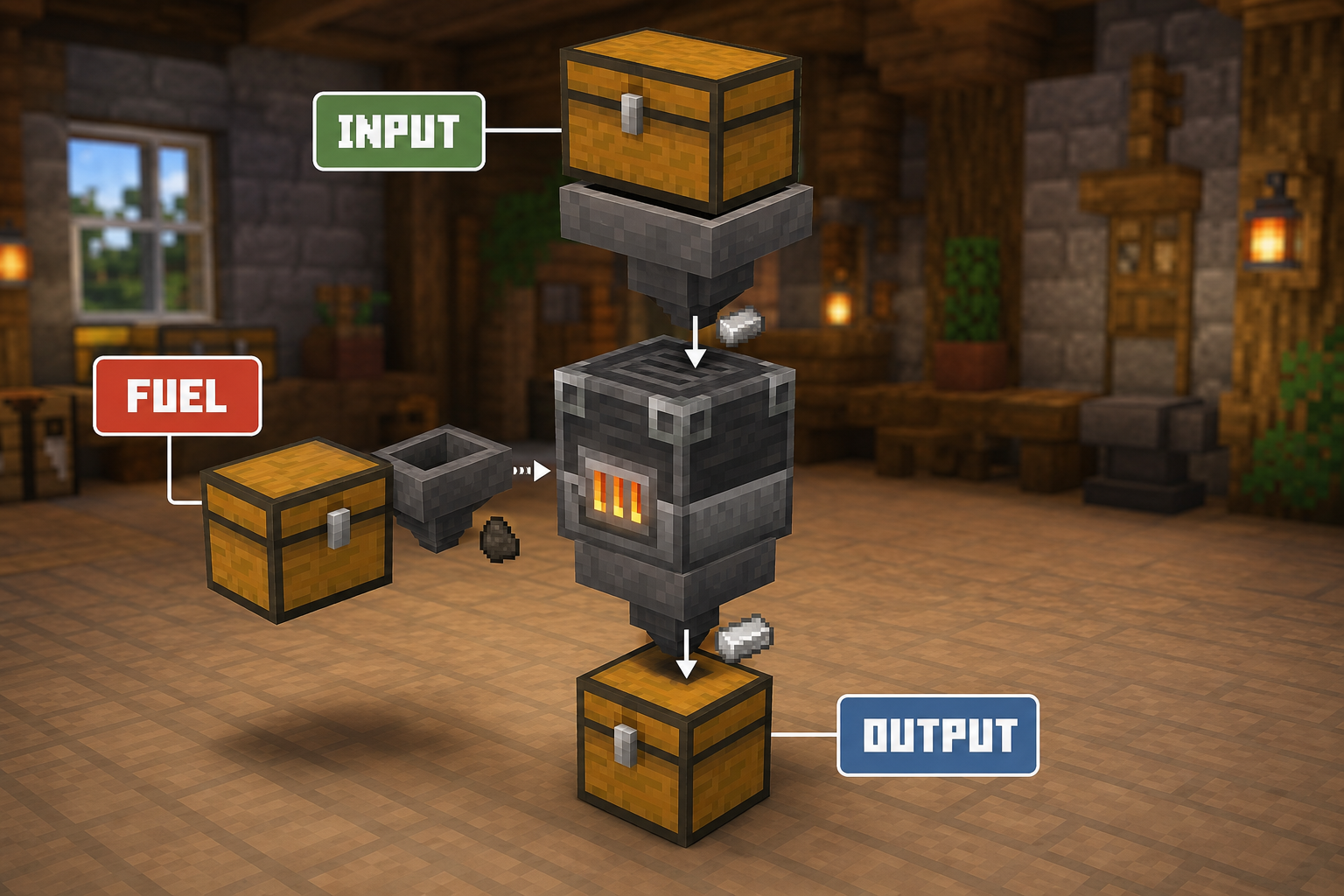
The simplest automatic blast furnace uses three hoppers and three chests. Put one chest above a hopper that feeds into the top of the blast furnace. This is your raw metal input. Put a second chest beside or behind a hopper that feeds into the side of the blast furnace. This is your fuel input. Put a hopper underneath the blast furnace leading into a third chest. This is your output. The system is compact, cheap, and easy to understand.
Hopper direction matters. A hopper on top feeds the item input slot. A hopper feeding into the side feeds the fuel slot. A hopper underneath pulls finished items from the output slot. If your system is not working, crouch while placing hoppers and make sure each hopper points into the correct block. The little hopper spout shows the direction. Misplaced hoppers are the most common automation problem.
For multiple blast furnaces, you can repeat the same module in a row. The simple version gives each blast furnace its own input and fuel chest. The better version uses water streams, hopper minecarts, or item sorters to distribute resources. Even without complicated redstone, four manual modules are powerful. Put raw iron in one, raw gold in another, raw copper in another, and recycled gear in the last.
Automatic fuel systems are worth planning. If you use coal manually, you will refill fuel chests often. If you have a bamboo farm, kelp farm, charcoal farm, or lava bucket setup, the blast furnace array becomes much easier to maintain. On servers with hopper limits, keep systems small and efficient. A beautiful automatic smelter that violates server rules is not useful.
Do not forget experience. When hoppers pull items out automatically, experience is usually stored in the furnace block until a player manually removes an item or interacts in specific ways depending on version mechanics. Some players use furnace XP banks, although mechanics can vary by edition and updates. If you care about XP, research your exact version before designing around stored furnace experience. If you only care about ingots, output hoppers are perfect.
Best items to process in a blast furnace
Raw iron is the top blast furnace item for most players. Iron is used for hoppers, anvils, rails, minecarts, buckets, shears, shields, pistons, compasses, cauldrons, iron doors, iron trapdoors, and countless redstone components. Since hoppers alone consume 5 iron each, a base can burn through iron quickly. A blast furnace helps turn raw iron into usable ingots without slowing down your building session.
Raw gold is another excellent choice. Gold is used for powered rails, golden apples, clocks, light weighted pressure plates, piglin bartering, netherite upgrade preparation, and decorative blocks. If you mine in the Nether, explore badlands, or run gold farms, blast furnaces make cleanup faster. Smelting unwanted gold swords from certain farms can also produce nuggets, though the return is small.
Raw copper is where blast furnaces really shine for builders. Copper veins can produce huge amounts of raw copper, especially with Fortune. If you are building roofs, statues, steampunk bases, industrial machines, oxidized copper gradients, or decorative blocks, you may need stacks of copper ingots. Regular furnaces feel slow when processing that much copper. Blast furnace arrays turn copper building from waiting into crafting.
Iron and gold gear recycling is useful after mob farms, bastion runs, ruined portal loot, dungeon loot, and server kit cleanup. Again, do not expect huge returns. The main benefit is tidiness. Instead of keeping damaged helmets, swords, boots, and chestplates forever, smelt them into nuggets and move on. In large storage systems, this can reduce clutter.
Ore blocks mined with Silk Touch are situational. If you plan to use Fortune later, do not smelt them. If you want quick ingots and already chose to mine with Silk Touch, the blast furnace processes them quickly. This is common when players use one Silk Touch pickaxe for all mining and sort ore blocks at home. A blast furnace gives you the option to process those blocks without swapping tools during the mining trip.
What a blast furnace cannot do
A blast furnace cannot cook food. It will not cook beef, porkchops, chicken, mutton, rabbit, cod, salmon, potatoes, or kelp. Use a smoker for fast food cooking or a regular furnace if you have no smoker. This is probably the most common disappointment for new players who expect the blast furnace to be a straight upgrade.
A blast furnace cannot make glass. Sand, red sand, and related glassmaking jobs belong in a regular furnace. If you are a builder making windows, glass panes, tinted glass ingredients, or decorative glass walls, keep regular furnaces around. The blast furnace is not part of a glass factory unless your server has custom recipes.
A blast furnace cannot make smooth stone. This is especially important because smooth stone is required to craft the blast furnace itself. You need a regular furnace for cobblestone to stone and stone to smooth stone. Even after crafting your first blast furnace, the regular furnace remains necessary for future blast furnaces, armor stands, building blocks, and general smelting.
A blast furnace cannot make charcoal from logs. Charcoal is an early-game fuel lifesaver, but it requires a normal furnace. If you rush a blast furnace and then remove your normal furnace, you may accidentally remove your ability to make fuel from wood. Keep at least one regular furnace in your starter base for charcoal and flexible smelting jobs.
A blast furnace cannot smelt clay into bricks, cactus into green dye, netherrack into nether bricks, chorus fruit into popped chorus fruit, wet sponges into dry sponges, or many other general furnace recipes. The short version is simple: metal goes into the blast furnace; broad smelting goes into the furnace; food goes into the smoker.
Best servers and game modes for testing blast furnaces
If you want to practice how to make a blast furnace in Minecraft without risking your main base, Creative servers are the easiest testing ground. You can instantly place crafting tables, furnaces, smooth stone, hoppers, chests, and redstone components. Creative plots are perfect for designing blast furnace arrays, testing hopper directions, comparing furnace vs blast furnace speed, and planning a workshop wall before you spend resources in Survival.
Survival SMP servers are better for real progression. On a normal SMP, you feel the actual value of the blast furnace because you have to mine iron, craft smooth stone, gather fuel, and decide where the block fits in your base. If the server is close to vanilla, the blast furnace recipe should behave normally. Claims protect your utility blocks, and community markets may let you buy extra smooth stone, fuel, or iron ingots.
Skyblock servers make the blast furnace more interesting because resources are often controlled by generators, shops, minions, or island upgrades. The recipe may be vanilla, but the economy around iron and smooth stone can be different. In Skyblock, a blast furnace can become part of an island production chain instead of a normal cave-mining workflow. Always check the server's custom recipe menu.
Prison servers often focus heavily on mining, which makes blast furnace keywords naturally relevant, but many prison servers replace vanilla smelting with custom sell systems, autosell, backpacks, tokens, enchantments, or mines. A blast furnace might be decorative, disabled, or part of a special feature. If you are writing content for a Minecraft server list, mention that vanilla blast furnace behavior depends on the server's game mode.
Modded servers are the wild card. Technology modpacks may add machines that outperform the vanilla blast furnace, such as crushers, enrichment chambers, powered furnaces, alloy smelters, pulverizers, or electric furnaces. In those worlds, the vanilla blast furnace may be a stepping stone, a villager block, or a recipe ingredient. The vanilla guide still helps, but modpack progression can change the importance of the block.
The no-waste crafting plan
If you want the cleanest possible way to craft a blast furnace in survival, think in terms of a short production chain instead of three disconnected ingredients. The chain is: mine cobblestone, craft a regular furnace, smelt iron, smelt stone twice, pick up the furnace, then craft the blast furnace. This matters because the recipe consumes the normal furnace. If you craft a furnace, use it, and then forget to mine it back up, the final recipe will look impossible even though all the other ingredients are ready.
The no-waste plan starts with 11 cobblestone and 5 raw iron. Eight cobblestone become the regular furnace. Three cobblestone become the three smooth stone blocks. The 5 raw iron become the 5 iron ingots. The only flexible part is fuel. Two coal are enough for the whole setup because the recipe needs 11 regular furnace smelts before the blast furnace exists. One coal covers 8 smelts, so one coal is not enough from absolute scratch. If you already have iron ingots, smooth stone, or a furnace in storage, the fuel requirement drops.
A good survival order is iron first, smooth stone second. Smelt the 5 raw iron into ingots before you smelt the stone twice. That way, if night arrives, a cave gets dangerous, or you need to leave your base, you already have iron for a shield, bucket, pickaxe, or shears. Smooth stone is useful, but iron tools and defense are usually more urgent. Once the iron is done, put three cobblestone into the furnace, take out three stone, put the stone back in, and take out three smooth stone.
If you only have one furnace, the fastest workflow is to prepare the crafting grid while the last smooth stone smelts. Open your inventory, keep the 5 iron ingots together, keep the smooth stone in a separate slot, and make sure your pickaxe is on the hotbar. When the final smooth stone finishes, break the furnace with the pickaxe, open the crafting table, and place the blast furnace recipe immediately. It is a tiny optimization, but it makes the process feel much smoother, especially when writing a tutorial for new Minecraft players.
If you have enough cobblestone for two furnaces, the process becomes faster. Craft two regular furnaces. Use one furnace to smelt the 5 raw iron and the other furnace to process cobblestone into stone. When the stone is finished, use either furnace to make smooth stone. Then break only one furnace for the recipe and keep the second regular furnace in your base. This is often the best early-game route because you do not lose your only general-purpose furnace when you craft the blast furnace.
That last point is important for real gameplay. A blast furnace cannot replace the normal furnace, so sacrificing your only furnace can be annoying. If you craft a blast furnace and then immediately need charcoal, glass, stone, or cooked food, you will have to craft another regular furnace anyway. The smarter starter-base plan is to make two furnaces from the beginning: one becomes the blast furnace, and one stays as the flexible smelter.
| Goal | Best material plan | Why it works |
|---|---|---|
| One blast furnace only | 11 cobblestone, 5 raw iron, 2 coal | Covers the furnace, smooth stone, iron ingots, and all required smelting. |
| Blast furnace plus spare furnace | 19 cobblestone, 5 raw iron, 2 coal | Lets you keep one normal furnace for glass, charcoal, food, and smooth stone. |
| Four blast furnaces | 44 cobblestone, 20 raw iron, enough fuel for 44 smelts | Good for a mining room, copper processing wall, or early automatic smelter. |
| One armorer villager | 1 blast furnace plus a reachable villager area | The blast furnace becomes a job site block, not just a smelting block. |
Blast furnace speed examples
The phrase "twice as fast" is accurate, but it is still abstract until you see the numbers. A normal furnace takes about 10 seconds to smelt one item. A blast furnace takes about 5 seconds for eligible items. That means a stack of 64 raw iron takes around 640 seconds in one regular furnace, which is about 10 minutes and 40 seconds. The same stack takes around 320 seconds in one blast furnace, which is about 5 minutes and 20 seconds. That is the real value of the block.
Parallel smelting makes the difference even stronger. Four regular furnaces can process four stacks of raw metal in the time one regular furnace processes one stack. Four blast furnaces process those same eligible stacks in about half that time. This is why experienced Minecraft players build smelting walls instead of relying on one utility block. The blast furnace is good alone, but it becomes excellent when several of them work together.
For a small mining trip, the time difference might not feel huge. Ten raw iron items take about 100 seconds in a furnace and about 50 seconds in a blast furnace. That saves less than a minute. For serious mining, Fortune III, copper-heavy building, beacon mining, or server resource grinding, the time savings are massive. Six stacks of raw copper in a regular furnace can feel like a waiting room. Six stacks through a small blast furnace array become a normal part of the workflow.
The fuel behavior is where players often misunderstand the block. Because fuel burns faster in a blast furnace, you do not get more items per coal. You get the same item value faster. A blast furnace is not a magic fuel saver, and it does not make coal, charcoal, lava, bamboo, or kelp more efficient. It compresses time. If your problem is "I need ingots now," the blast furnace solves it. If your problem is "I have no fuel," the blast furnace does not solve it.
Here is the practical rule: build blast furnaces when time is your bottleneck, build fuel farms when fuel is your bottleneck, and build more modules when both are bottlenecks. A Minecraft base with 16 blast furnaces and no fuel supply still stalls. A base with infinite bamboo and only one blast furnace still processes raw metal slowly. The strongest ore processing room balances input speed, fuel supply, and output storage.
| Items to smelt | One regular furnace | One blast furnace | Four blast furnaces |
|---|---|---|---|
| 16 raw iron | About 160 seconds | About 80 seconds | About 20 seconds if evenly split |
| 64 raw copper | About 640 seconds | About 320 seconds | About 80 seconds if evenly split |
| 128 raw gold | About 1,280 seconds | About 640 seconds | About 160 seconds if evenly split |
| Gear recycling | Slow cleanup | Fast cleanup | Fast enough for farm output |
Long-tail mistakes players actually search for
"Why can't I make a blast furnace in Minecraft?" usually has a boring answer, but the boring answer is exactly what the article needs to cover. The first mistake is using normal stone. Normal stone is the block you get after smelting cobblestone once. Smooth stone is the block you get after smelting normal stone again. The texture is cleaner and lighter. If the bottom row does not say smooth stone in the tooltip, it is the wrong block.
"Why won't smooth stone work for a blast furnace?" usually means the player made smooth stone slabs. The recipe needs smooth stone blocks, not slabs. This is extra confusing because smooth stone slabs are involved in the armor stand recipe, and many players learn those two utility recipes around the same time. If the item name includes "slab," it does not belong in the blast furnace recipe. You need three complete blocks across the bottom row.
"Can you make a blast furnace with cobbled deepslate?" has two answers. You may be able to use cobbled deepslate or other accepted stone variants to craft a regular furnace depending on version support, but the blast furnace recipe itself still wants a furnace item in the center. The bottom row is still smooth stone. Deepslate does not replace smooth stone in the blast furnace recipe. If a server or modpack allows an alternate recipe, that is custom behavior, not the vanilla answer.
"Can you use raw iron instead of iron ingots?" No. Raw iron must be smelted first. The blast furnace recipe uses finished iron ingots, because the block is a crafted workstation rather than an ore-processing input. Raw iron goes into a furnace or blast furnace as smelting input after the block exists. It does not work as the iron part of the recipe.
"Can a blast furnace smelt diamonds or emerald ore?" A blast furnace can smelt certain ore blocks, but smelting valuable ores is often a bad idea if Fortune is available. Diamond ore and emerald ore are normally mined for gems, and Fortune increases drops. Smelting ore blocks is usually relevant for iron, gold, copper, or special Silk Touch situations. Do not smelt every ore blindly. Good Minecraft resource handling depends on the item, the tool enchantments, and whether you need drops, blocks, or fast ingots.
"Why is my blast furnace not taking sand?" Because sand becomes glass, and glass is a regular furnace recipe. The same applies to cobblestone, logs, clay, cactus, netherrack, wet sponge, and food. The block name sounds powerful, but the accepted recipe list is narrow. This is not a bug. It is the design: blast furnace for metals, smoker for food, furnace for general smelting.
"Why did my blast furnace disappear when I broke it?" You probably mined it without a pickaxe. A blast furnace must be broken with a pickaxe to drop itself. If you break it by hand, it does not drop. This is easy to forget in a starter base when moving blocks around quickly. Use any pickaxe, even a wooden one, if you want to pick up the block safely.
Common searches answered in plain Minecraft terms
If you searched for "minecraft blast furnace recipe," the answer is the shaped recipe: iron ingot, iron ingot, iron ingot; iron ingot, furnace, iron ingot; smooth stone, smooth stone, smooth stone. If you searched for "how to craft blast furnace," the missing detail is usually the crafting table. You need the 3x3 grid. The 2x2 inventory grid is too small, even if you already have every ingredient.
If you searched for "blast furnace not working," check the stone first. The bottom row must be smooth stone blocks. If you searched for "how to make smooth stone for blast furnace," the process is two furnace steps: cobblestone becomes stone, then stone becomes smooth stone. If you searched for "can you use smooth stone slabs for blast furnace," the answer is no. Slabs are the wrong item. Keep the smooth stone as full blocks.
If you searched for "what does a blast furnace do in Minecraft," the answer is fast metal smelting. It handles ores, raw metals, ore blocks, and smeltable metal gear. If you searched for "can blast furnace cook food," the answer is no. Use a smoker for food. If you searched for "can blast furnace smelt stone," the answer is also no. Use a regular furnace for cobblestone, stone, smooth stone, glass, bricks, charcoal, and general smelting.
If you searched for "blast furnace vs furnace," the real difference is speed versus flexibility. The blast furnace is faster for metal-related items. The regular furnace accepts far more recipes. If you searched for "blast furnace vs smoker," the split is even cleaner: blast furnace for metal, smoker for food. A well-organized Minecraft base uses all three instead of forcing one block to do every job.
If you searched for "blast furnace villager job" or "armorer villager workstation," the blast furnace is the block you need. Place it near an unemployed villager, make sure the villager can claim it, and the villager can become an armorer. If you searched for "automatic blast furnace Minecraft," the hopper rule is simple: input from the top, fuel from the side, output from the bottom. Those small search phrases all point back to the same block, but they answer very different gameplay problems.
Version notes and old-guide confusion
Old Minecraft information can make the blast furnace recipe feel more confusing than it really is. Blast furnaces became part of modern village and workstation gameplay around the Village and Pillage era, and smooth stone also has history that causes naming confusion. Older players may remember "stone slab" naming, older guides may show outdated terminology, and some search results are written for versions where the modern block list did not behave the same way.
If you are playing a modern version such as Minecraft 1.20, 1.21, or a current server release, use the recipe in this guide: 5 iron ingots, 1 furnace, 3 smooth stone. If you are playing a much older version, the block may not exist, smooth stone may not behave the same way, or the recipe book may not help. This is especially relevant for players on old modpacks, old console versions, legacy servers, or private worlds that have not updated in years.
Recipe-book confusion is also real. Sometimes the recipe book does not show what players expect because the craftable filter is on, the player has not picked up one of the ingredients, the world has custom recipes, or the interface is behaving oddly. The manual recipe is the more reliable explanation. If you place the items correctly and the world supports the vanilla recipe, the blast furnace output appears.
Texture names can cause another problem. Normal stone looks like what a new player might call smooth stone, but Minecraft uses "smooth stone" for a specific lighter block made by a second smelt. In a written guide, always say "smelt cobblestone into stone, then smelt stone into smooth stone" rather than simply saying "get smooth stone." That extra sentence prevents more failed recipes than any image alone.
Modpacks can override everything. In a technology pack, a blast furnace might be replaced by a custom machine, upgraded into an alloy system, locked behind quests, or used as a component for advanced crafting. In a vanilla-plus datapack, the recipe might remain unchanged but the smelting list might expand. In a minigame server, the block might be disabled. Use the vanilla rule as the baseline, then check the server's recipe book, quest menu, or wiki when a custom world behaves differently.
Survival progression: when should you craft it?
You do not need a blast furnace in the first five minutes of every world. The first priorities are usually wood, stone tools, food, shelter, torches, a bed if possible, and enough iron for immediate survival tools. A shield, bucket, and iron pickaxe can be more important than faster smelting if you only have 5 to 8 iron ingots total. The blast furnace is best once you have spare iron or once you know you are about to process a lot of ore.
The best early timing is after your first serious cave run. If you come home with 20 or more raw iron and some coal, craft the blast furnace. It will speed up the rest of your progression because iron becomes tools, armor, hoppers, and utility blocks faster. If you also found raw gold or raw copper, even better. The blast furnace starts saving time right away.
For builders, the timing can be copper-driven. Copper builds require huge ingot counts, and raw copper drops can pile up quickly. If your base plan includes copper roofs, oxidized copper gradients, exposed copper trim, lightning rods, or industrial details, make multiple blast furnaces earlier than usual. The blast furnace is not only a mining upgrade; it is also a building-material accelerator.
For redstone players, the timing is hopper-driven. Hoppers cost iron, and hoppers are often needed in bulk. If you are building farms, item sorters, auto smelters, brewing systems, or storage systems, turning raw iron into ingots faster speeds up everything else. A blast furnace is a small investment that supports bigger technical builds.
For villager players, the timing is profession-driven. If you find a village and want armorers, the blast furnace becomes important even if you are not smelting much. It lets you assign an armorer job, reroll profession access before trading, and build a trading hall around armor-related progression. In that context, the block's job-site role can be more valuable than its smelting speed.
Advanced automation ideas
The basic hopper setup is enough for most players, but a more advanced blast furnace system solves three separate problems: distribution, fuel, and collection. Distribution decides how raw metals are spread across multiple blast furnaces. Fuel decides how each furnace stays powered. Collection decides where finished ingots go. If any of those three parts fails, the system becomes slower than expected.
For distribution, the simplest approach is manual splitting. Put one stack in each blast furnace. This is low-tech and reliable. The next step is a hopper line, but hopper lines can fill the first furnace before later furnaces receive items. Better systems use hopper minecarts, water streams with timed pickups, or redstone locking to distribute stacks more evenly. The goal is to avoid one busy blast furnace and seven idle ones.
For fuel, decide whether the system is manual, semi-automatic, or farm-fed. Manual fuel chests are fine for small bases. Semi-automatic fuel might use a bamboo farm or kelp farm feeding a chest that you refill occasionally. Fully automatic fuel systems can feed bamboo, dried kelp blocks, charcoal, or lava buckets depending on your version and design. The best fuel is not always the highest burn-time item; it is the fuel your base can produce consistently.
For collection, output hoppers are straightforward. Place hoppers underneath each blast furnace and route them into a chest, barrel, item sorter, or water stream. If you want XP from smelting, think carefully before pulling every item automatically, because furnace XP behavior can depend on version and exact setup. If you only want ingots, automatic extraction is clean. If you want XP banking, design around that from the start.
A late-game ore room can connect a mining dump chest to item filters: raw iron to one blast furnace bank, raw gold to another, raw copper to another, and non-smeltable blocks to storage. That kind of system feels overbuilt until you return from a beacon mining session with shulker boxes of resources. Then it feels amazing. The blast furnace is a small block, but in a technical base it can be the engine of the entire resource pipeline.
Copy-ready short answer
To make a blast furnace in Minecraft, use a crafting table and combine 5 iron ingots, 1 furnace, and 3 smooth stone. Place iron ingots across the top row, put one iron ingot on each side of the middle row, place the furnace in the center, and place smooth stone across the bottom row. The Minecraft blast furnace recipe creates 1 blast furnace. You need smooth stone blocks, not stone slabs. The blast furnace is used to smelt ores, raw metals, and metal tools or armor faster than a regular furnace. It also works as the armorer villager job site block.
If you are starting from scratch, gather 11 cobblestone and 5 raw iron. Use 8 cobblestone to craft a furnace. Smelt 5 raw iron into 5 iron ingots. Smelt 3 cobblestone into 3 stone, then smelt those 3 stone into 3 smooth stone. Pick up the furnace with a pickaxe, open the crafting table, and place the items in the blast furnace crafting pattern. That is the complete answer to how to make a blast furnace in Minecraft survival mode.
A blast furnace is useful because it processes eligible metal items at double speed. It is ideal for raw iron, raw gold, raw copper, iron ore, gold ore, copper ore, and unwanted iron, gold, or chainmail gear. It is not useful for food, glass, smooth stone, charcoal, bricks, cactus, or general smelting. For the best base setup, use a regular furnace for general items, a smoker for food, and a blast furnace for metals.
Frequently Asked Questions
What is the exact blast furnace recipe in Minecraft?
The exact Minecraft blast furnace recipe is 5 iron ingots, 1 furnace, and 3 smooth stone blocks. In a 3x3 crafting table, place iron ingots across the top row, iron ingots in the middle-left and middle-right slots, a furnace in the center, and smooth stone across the bottom row. The output is 1 blast furnace.
Can you make a blast furnace with stone slabs?
No. A blast furnace uses 3 full smooth stone blocks, not smooth stone slabs and not regular stone slabs. Smooth stone slabs are used in other recipes, such as armor stands, but the blast furnace recipe requires full smooth stone blocks in the bottom row.
How do you make smooth stone for a blast furnace?
Mine cobblestone, smelt the cobblestone in a regular furnace to make stone, then smelt the stone again in a regular furnace to make smooth stone. For one blast furnace, you need 3 smooth stone blocks, so start with 3 cobblestone for the smooth stone part.
Can a blast furnace smelt cobblestone into stone?
No. A blast furnace cannot smelt cobblestone, stone, sand, food, clay, logs, cactus, or general furnace items. It only smelts metal-related items such as ores, raw metals, ore blocks, and iron, gold, or chainmail tools and armor. Use a regular furnace for cobblestone and smooth stone.
Is a blast furnace faster than a normal furnace?
Yes, but only for eligible items. A blast furnace smelts ores, raw metals, and metal gear twice as fast as a normal furnace. However, fuel is consumed at double speed, so it saves time rather than saving fuel. For non-metal recipes, it does not work at all.
Does the blast furnace recipe work on Java and Bedrock?
Yes. Modern Java Edition and Bedrock Edition use the same blast furnace recipe: 5 iron ingots, 1 furnace, and 3 smooth stone. The crafting table layout is also the same. Custom servers, datapacks, and modpacks can change recipes, but vanilla Minecraft uses this pattern.
Why is my blast furnace not crafting?
The usual reasons are using stone instead of smooth stone, using slabs instead of blocks, using raw iron instead of iron ingots, forgetting the furnace in the center, or trying to craft in the 2x2 inventory grid. Use a 3x3 crafting table and place the exact shaped recipe manually.
What villager uses a blast furnace?
The armorer villager uses a blast furnace as its job site block. Place a blast furnace near an unemployed villager during work time and the villager can become an armorer. This is useful for trading halls, armor trades, and profession control in villages.
Can you automate a blast furnace?
Yes. Put a hopper on top for raw metal input, a hopper on the side for fuel, and a hopper underneath for finished output. Connect chests to the hoppers and you have a simple automatic blast furnace. Larger systems use multiple blast furnaces in parallel for faster ore processing.
Is it worth making a blast furnace in Minecraft survival?
Yes, once you have spare iron. A blast furnace is worth making because it speeds up raw iron, raw gold, raw copper, and ore processing. It is especially useful after mining trips, in villager trading halls, and in bases with automatic smelting systems. Just keep a regular furnace too, because the blast furnace is not a universal replacement.
Minelist Team